
Edwards County Court Records After Arrest
Edwards County has no full county jail listed in the Illinois Sheriffs' Association profile. That fact changes the record path after a local arrest. The first custody question goes to the sheriff or a receiving jail, but the court record is handled through the Edwards County Circuit Clerk after the case is filed. The clerk's site states that the office files all cases that come before the Edwards County court system and that court files are public unless impounded or otherwise restricted.
The arrest side and the court side should be kept separate. A booking record may show a name, arrest date, arresting agency, or preliminary allegation when available from the sheriff. The court record after a jail arrest shows what the prosecutor filed, how the judge handled pretrial release, whether a warrant was issued, and what happened to each charge. For custody and booking details, use Edwards County jail inmate records. For booking-photo questions, use Edwards County jail mugshots.
The Edwards County Circuit Clerk case-search page routes users to Judici for local case lookup. During research, the Judici page showed hCaptcha before the form, so the live search fields could not be captured. That means a person searching Edwards County court records after an arrest should keep the clerk's phone and in-person options close at hand, especially for older, sealed, impounded, or newly filed cases.
Edwards County Court Contacts
The Circuit Clerk is the public-facing office for case files, copies, docket questions, and case numbers. The State's Attorney is the prosecutor who decides what formal charges to file after an arrest. The sheriff remains the contact for the short local custody stage, but filed court records after a jail arrest are not the same as a sheriff holding-cell log.
Edwards County Circuit Clerk
Amanda Willett
50 E. Main St., Suite 7
Albion, IL 62806-1262
618-445-2016
Fax: 618-445-4943
Edwards County State's Attorney
Eric St. Ledger
50 E. Main
Albion, IL 62806
618-445-3656
Fax: 618-445-3657
The Second Judicial Circuit Edwards County directory also lists the resident circuit judge, public defender, probation contact, circuit clerk, and State's Attorney. The Illinois Courts directory gives courthouse visitor details, including public hours, parking around the courthouse square, and court resources.
Find Court Records After Jail Arrest
The court lookup starts with a name, arrest date, or case number. If the arrest is very recent, the prosecutor may not yet have filed the case. Jail arrest allegations can also change when the prosecutor reviews reports, witness statements, prior case history, and probable-cause facts. The filed court record controls the charge list in the court system.
- Start with the arrest date, arresting agency, and full legal name. Call the Edwards County Sheriff's Office if the person was just taken into custody.
- Use the Circuit Clerk's Search Court Cases page and follow its Judici link for Edwards County.
- Search by defendant name or case number if the Judici portal is available. If hCaptcha or a restriction blocks access, call the Circuit Clerk.
- Open the criminal or traffic case and compare the filed charges with any booking or arrest information.
- Check future court dates, warrants, pretrial release entries, and dispositions charge by charge.
- Ask the Circuit Clerk about copies when the online entry does not show the document needed.
Illinois VINE may help with custody and criminal case notifications, but Edwards County jail-feed participation was not confirmed from a county page. VINE is a notification tool, not a full substitute for the local case file. For state-prison custody after sentencing, use IDOC. For federal or immigration custody, use BOP or ICE because those systems do not share the same local court-record path.
The official clerk-linked Judici screen is shown in the captured source at Judici's Edwards County case-search portal.
Because the inspected page required hCaptcha before displaying fields, phone and clerk-counter options remain important for Edwards County court records after an arrest.
Edwards County Case Search Fields
No complete Judici field inventory could be captured because the court-search page required a human verification step during research. The research still confirms that the Circuit Clerk links to Judici as the official online path for Edwards County case lookup. The table below keeps the field limits clear instead of inventing a roster-style form.
| Search Source | Field Status | Use in Court Records After Arrest |
|---|---|---|
| Judici Edwards County case search | Fields not accessible during inspection | Use when the portal opens, then search by defendant name or case number if available. |
| Edwards County Circuit Clerk | Phone and office assistance available | Use for newly filed cases, copy requests, restricted files, and docket questions. |
| Illinois VINE | Notification portal, not a full case-file index | Use for custody and criminal-case notifications where participating data exists. |
| Illinois State Police criminal history | Separate statewide background process | Use for eligible criminal-history requests, not for daily court docket review. |
Charges Filed After Arrest
A court record after an Edwards County jail arrest usually begins with a charging document. The document may be a complaint, information, or indictment. Each form has a different source, but all serve the same basic role: they move the case from a police or sheriff arrest into a court charge that can be heard by a judge.
| Document | Who Files or Returns It | What It Means |
|---|---|---|
| Complaint | Law enforcement or prosecutor | A formal accusation used to start many criminal cases after arrest. |
| Information | State's Attorney | A prosecutor-filed charge document often used after review of the arrest facts. |
| Indictment | Grand jury | A grand-jury charging document used in serious cases or where that process is chosen. |
Arrest charges and court charges can differ. The arrest entry reflects what the officer or arresting agency had at the time of custody. The State's Attorney decides what to file, whether to add charges, and whether to amend or dismiss a count later. That is why Edwards County court records after a jail arrest should be checked even when a custody source has already been found.
Charge Status in Edwards County Records
Charge status shows where each filed count stands. One case can have several counts, and each count may move in a different way. A felony count may remain pending while a misdemeanor count is dismissed. A charge may also be amended, reduced, or resolved by plea, trial, or dismissal.
| Status | Plain Meaning | Why It Matters After Arrest |
|---|---|---|
| Pending | The charge has not reached final disposition. | Future court dates and release conditions may still change. |
| Amended | The filed charge was changed after the original filing. | The court record may differ from the booking allegation. |
| Reduced | The charge level or offense was lowered. | The record may show both the original and later charge. |
| Dismissed | The charge ended without conviction. | Dismissal can matter for sealing or expungement review. |
| Convicted | The charge resulted in a guilty plea or finding. | Sentence, supervision, probation, jail, or prison records may follow. |
Note: A case result should be read from the court record, not assumed from the fact of arrest.
Court Copy and Research Fees
The Edwards County Circuit Clerk publishes copy, certification, email, and research charges on its official filing-fee page. These amounts apply when a person needs a document copy or clerk research beyond a simple online look. They are not jail bond, commissary, or release fees.
The clerk's fee source is shown at the Edwards County Circuit Clerk filing-fees page.
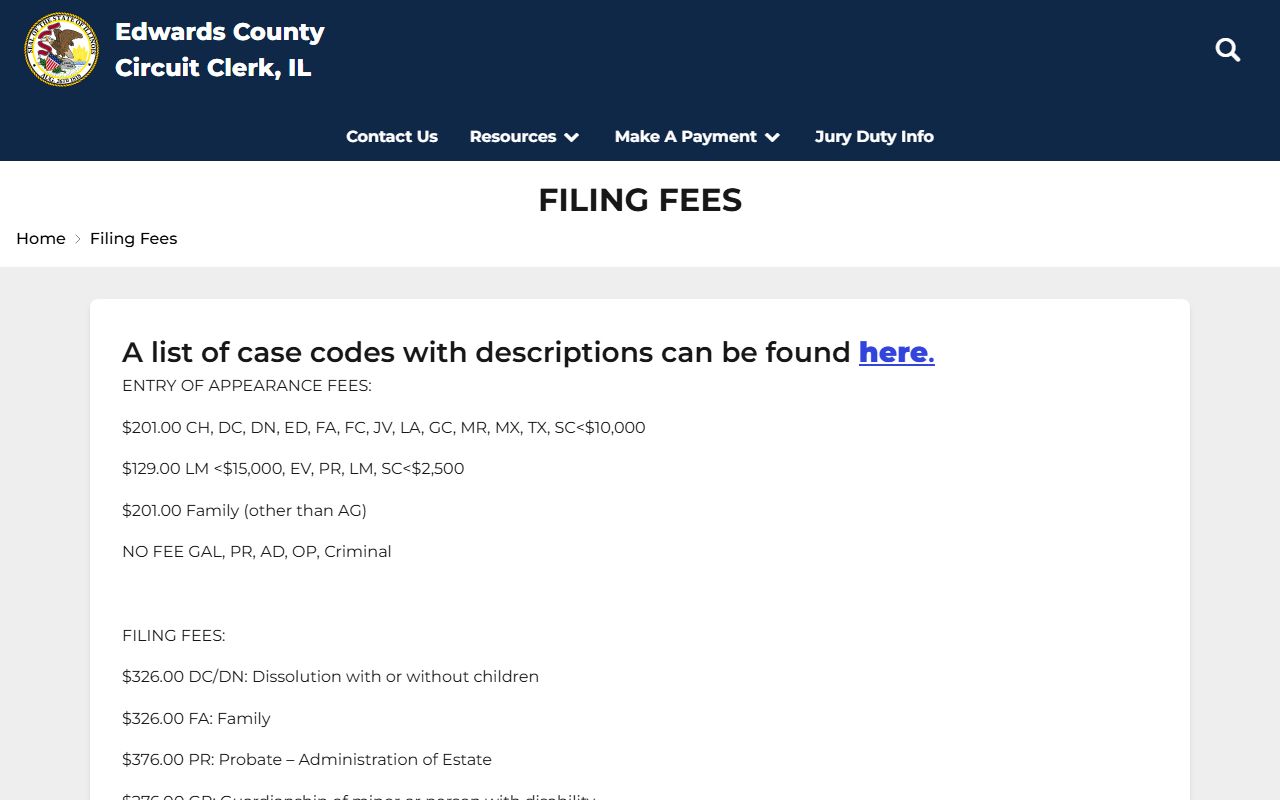
Those published clerk fees help separate court-record costs from jail-service costs, which is useful in Edwards County because no full county jail service page was found.
| Clerk Item | Published Amount |
|---|---|
| Certification | $6.00 |
| Copies | $0.50 per page |
| Email copies | $0.50 per page |
| Research fee | $6.00 per case request |
Pretrial Release After Arrest
Illinois no longer uses a traditional cash-bail system for new criminal cases. Under the Pretrial Fairness Act framework, release is governed by nonmonetary conditions unless detention is ordered after the legal process required by statute. The Edwards County court record after a jail arrest may therefore show release conditions, a detention petition, a detention hearing, or a warrant entry instead of a simple cash bond amount.
725 ILCS 5/110-2 governs pretrial release by nonmonetary means. 725 ILCS 5/110-6.1 covers petitions to deny pretrial release and the detention-hearing burden. Edwards County also has an Office of Statewide Pretrial Services page for the courthouse.
| Term | Meaning in Current Illinois Practice |
|---|---|
| Pretrial release | Release before final case outcome under court-ordered conditions. |
| Detention petition | A State request asking the court to deny release under statutory grounds. |
| Detention hearing | A hearing where the State must meet its legal burden to keep a person detained. |
| Warrant or hold | A court order or outside-agency notice that may keep a person in custody. |
Warrants After Edwards County Arrest
No official Edwards County active warrant search or sheriff warrant list was located. Warrant questions should start with the sheriff for law-enforcement custody and the Circuit Clerk for case events. Judici may show warrants or failure-to-appear activity when a case is visible, but it should not be treated as a complete warrant-clearance source.
- Arrest warrant
- A court order authorizing law enforcement to arrest a person.
- Bench warrant
- A judge-issued warrant, often tied to failure to appear or failure to comply.
- Search warrant
- An order authorizing a search of property, not a custody lookup.
- Detainer
- A notice or hold from another agency that may affect release or transfer.
A warrant can lead to booking, a short hold, transfer to a receiving jail, or a new court date. In Edwards County, the absence of a public jail roster makes direct phone verification more important than in counties with full jail dashboards.
Charges and Convictions Compared
A charge is an accusation in a court case. A conviction is a final result after a guilty plea, bench finding, jury verdict, or other conviction event. Edwards County court records after an arrest can show charges that never become convictions, so the final disposition must be read before using a case entry as a result.
| Point | Charge | Conviction |
|---|---|---|
| Stage | Filed accusation after arrest review | Final guilty result or finding |
| Proof | Less than trial proof | Beyond a reasonable doubt or admitted by plea |
| Can change | May be amended, reduced, or dismissed | May be appealed, vacated, sealed, or expunged only through later process if eligible |
| Record use | Shows what was alleged | Shows legal outcome and sentencing effect |
Sealed and Expunged Records
Some Edwards County court records after a jail arrest may be restricted. Juvenile records, impounded files, sealed cases, expunged arrests, and safety-sensitive material may not appear in public search. Illinois approved forms for sealing and expungement are maintained by the courts, and the Office of the State Appellate Defender publishes plain-language expungement and sealing information.
| Record Action | Public Access Effect | Where to Start |
|---|---|---|
| Sealing | Restricts public view but does not erase every government-access path. | Illinois Courts expungement and sealing forms |
| Expungement | Removes qualifying arrest or case records from public access as allowed by law. | OSAD expungement information |
| Impoundment | Limits access by court order or rule. | Ask the Circuit Clerk whether a public docket or order is available. |
Illinois State Police lists a criminal-history fee schedule, including a listed charge for a court order to expunge or seal criminal history. The court process and the state police record process are related, but they are not the same as a local jail roster search.
Public Access Limits After Arrest
Illinois FOIA presumes many public records are open unless an exemption applies. FOIA arrest-report rules require certain arrest information to be furnished as soon as practical and no later than 72 hours after arrest, subject to law-enforcement, safety, and correctional-security exceptions. Court files are handled through court access rules and clerk practice, not only FOIA.
Important: Do not use informal court, arrest, or custody lookups for credit, employment, insurance, tenant screening, or other FCRA-covered decisions.